
Intro
If you do not already know, the term Eucharistic miracle refers to any miraculous phenomena that occurs related to the Eucharist, the Christian sacrament of eating the Bread and Wine that Jesus said was his Body and Blood. Virtually all of these cases happen within the Catholic Church, where over the centuries, a variety of miracles have been attributed to consecrated Eucharistic hosts (the wafer-like bread used in communion). The most famous of these cases involve consecrated hosts being thought to have turned into actual flesh and blood, most famously at Lanciano in c. 750 AD. The miracles, particularly the flesh and blood cases, are used by some Catholics to defend the Church’s unique doctrine of transubstantiation, the literal change of the substance of the Bread and Wine into Christ’s Body and Blood.
In recent years, it seems there has been a great uptick of interest in these miracles. It feels like every day, there is a new book published, blog posted, or video released on the topic. Even Google Trends shows a strong increase in interest over the past 5 years:

Part of the heightened interest is doubtlessly caused by the canonization of Carlo Acutis, an Italian teen known for cataloging these miracles online, who died of leukemia in 2006. It is also plausible that the occurrence of modern, and more scientifically documented, miracles like the ones in Buenos Aires in the 90s,1 have brought what was once an almost forgotten part of medieval legend into a subject of modern fascination.
The modern cases and the science behind their analysis have been litigated by (quite talented) researchers like Stacy Trasancos, Franco Serafini, and Ethan Muse, who have tackled the chains of custody, blood typing, bacteria, and scientific reporting2 relating to the miracles. But, what I have not seen completed is a long term and statistical analysis of the Eucharistic miracle phenomenon. In this piece, I want to approach these miracles from a new perspective, and use visualized Eucharistic miracle data to ask and answer new questions about these miracles. This will shed light on the different types of miracles, their prominence in different places and time periods, and the common motifs that some of them possess.
To explore the phenomenon, we will first need a dataset of miracles to work with.
Inspiration
This project was partially inspired by a graph made by blogger Skeptasmic, who made the point that Eucharistic miracle claims peaked in the years after the codification of the transubstantiation doctrine at the Fourth Council of the Lateran in 1215, and began to recede during the Protestant Reformation, when this doctrine fell out of favor in many European nations. Skeptasmic used these facts to attack the credibility of the miracle claims, believing them to be products of human caprice rather than divine intervention.

I could see a point to what Skeptasmic was saying, but frankly, I did not trust the graph on its face. This is because I assumed that the graph’s dataset came from this page on Wikipedia, or its source: Carlo Acutis’s list of miracles.3 Both lists have deep problems, and I wanted to see if the results would be replicated using an improved dataset.
Methodology
But what problems do they have, and how did I produce my dataset? The chief problem with the Acutis list is that it does not include many miracle claims made in the last ~20 years (the years after his death). Another problem is that the Acutis list has some strange additions, which I thought better to remove from my dataset. A third is that it can merge together separate miracle claims into one page, skewing the amount of miracles it contains.
In recent months, Wikipedia has addressed some of the problems with the original Acutis list. Newer cases have been added, and the data is better tabulated and easier to work with. This is why I used its page “List of Eucharistic miracles” as the base of my data. Their list of claims rejected by Church authorities was not added to my dataset.
Once I had the base data, I had to clean up certain parts of it, like breaking up conjoined miracles like those at Buenos Aires and standardizing dates (vague dates like “11th century” were changed to “1050” for machine readability). Some “cases” listed, like general relics of Jesus’s blood claimed to be from the Apostolic age, were removed as they had nothing to do with the Eucharistic host. This happened more often than one would expect in the Acutis list.
Then came the task of adding the relevant data I was looking for. Five data points were added to each miracle: Miracle City/Name, Year, Modern Country, Type, and Doubters?. The first three categories are self-explanatory.
The Type category referred to what type of Eucharistic miracle this was. This point has seven options:
Flesh and Blood refers to the host turning into actual flesh and/or blood.
Mystical Survival refers to the host surviving being stolen in a mystical manner.
Survival and Flesh/Blood refers to cases where both of the prior occurrences happen to the same hosts.
Appearance of Jesus Imagery refers to Jesus-related images appearing in or around the host.
Multiplying Hosts refers to hosts multiplying and never running out during Communion.
Peril Stopped by Eucharist refers to when invasions, floods, fires, or other perils are stopped by invoking the Eucharistic host.
Other refers to cases that do not involve the topics of any of the prior categories.
Doubters? refers to the fact that many cases involve someone Catholic, typically a priest, doubting transubstantiation, and a miracle occurring to strengthen their faith. So, a data point was added to each claim to reflect whether the doubt motif was involved or not. Other cases recorded that include people miraculously receiving communion (like having it given to them by angels, sustaining exclusively on it for long periods of time, etc.) are considered separate phenomena then the miracles occurring with the Eucharistic host itself, and hence are not included in the dataset.
If further information needed to be gathered about a miracle claim, the Acutis list was used for the miracles present on his list, and Wikipedia’s sources were used for those not present on the Acutis list. The date of this post’s publication is the date the materials used were last accessed, unless otherwise stated.
The dataset is titled “Eucharistic Miracles Dataset V1”, and can be downloaded here:

I would have made the file into a csv, but alas, Substack only supports PDF files.
Results
With the final dataset complete, I was left with 112 Eucharistic miracles to work with. The first question I wanted answered was: Does Skeptasmic’s graph hold up?
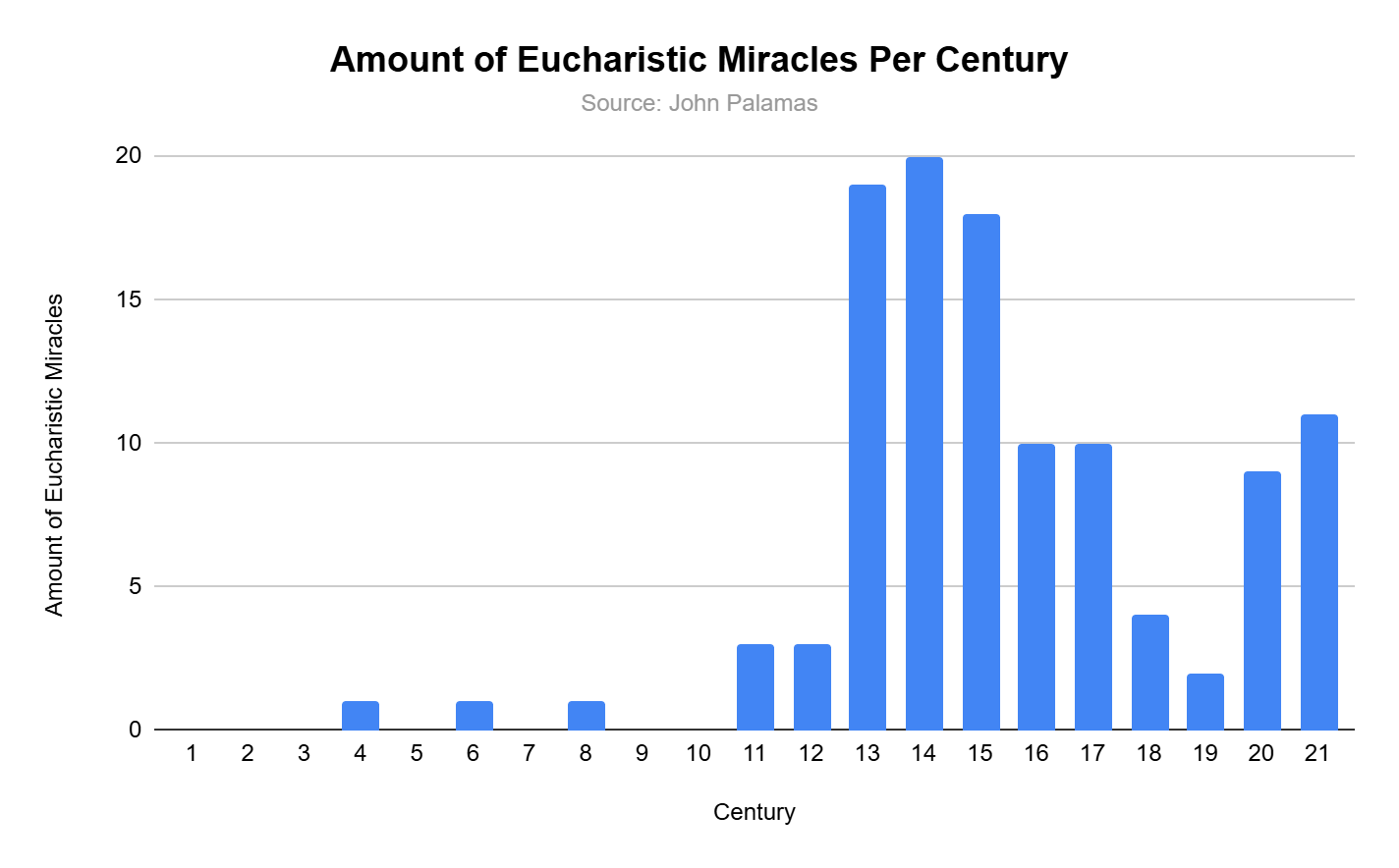
For the most part, it does! The trend of eucharistic miracles beginning in the 11th century, dramatically rising in the 13th century, and declining by the 16th century holds. What Skeptasmic did not visualize, however, was the increase in these miracles in the 21st century. I believe this is because his dataset is based on the Acutis list, and is about 20 years out of date. Then I had another idea. Seeing as we are only 25 years into the 21st century, what if we extrapolated the data to project the full amount of miracles in the 21st century? There have been 11 miracles so far this century, so doing some simple multiplication gives us 44 projected Eucharistic miracles by 2100. Let’s visualize.
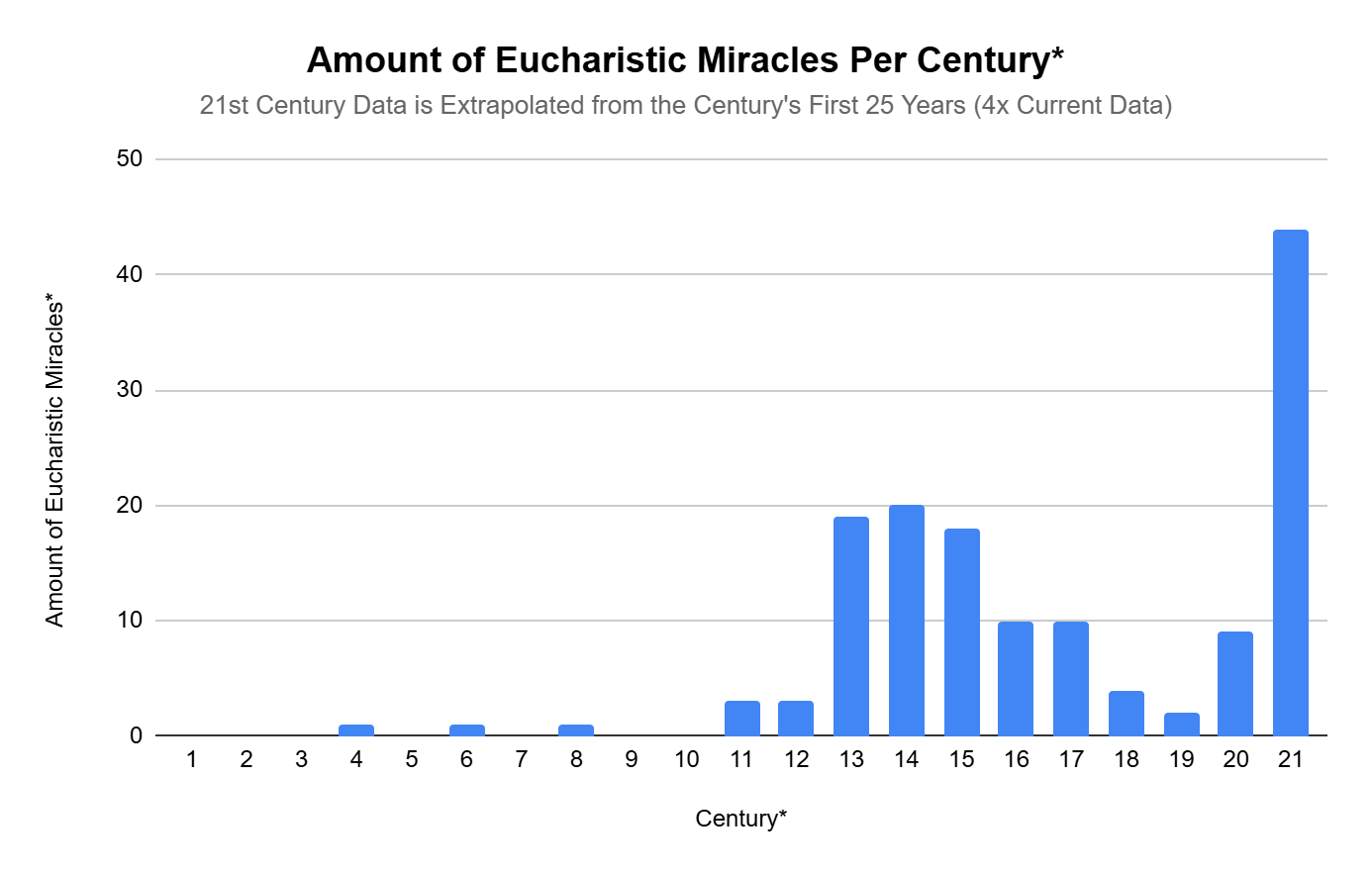
Wow! The difference between the 12th and 13th centuries was an increase of 16 miracles, while the projected difference between the 20th and 21st centuries is 35 miracles! The dramatic increase in the 21st century means that if one is to take a naturalistic view of Eucharistic miracles, the advent of modernity has had more than double the impact of the Ecumenical Council which codified the very doctrine underpinning the concept of a Eucharistic miracle! The same goes for the Reformation: the increase of Eucharistic miracles in the 21st century is also a steeper change than half of Europe adopting theology opposing transubstantiation.
To explain the 21st century’s increase, naturalistic causes could be proposed: maybe modern technology and record-keeping have allowed us to know of miracles that previously would have just been lost to time? Maybe the worldwide increase in the number of Catholics following population growth has something to do with it?4 Maybe something else? To me at least, it does not seem like any explanation I can think of is particularly strong or insightful, and certainly could not have as much explanatory power as the introduction of transubstantiation itself. The strangeness of the increase in these miracles is also so potent because the 21st century is thought of as one of the least religious times in human history, which is an inherent inhibition for any explanation of recent increases in these miracles.
This exhibits, to me at least, that Eucharistic miracles as a concept cannot be handwaved away as just a product of introducing new Catholic dogma that went away once it fell out of favor. But what about other ways of looking at the data? Next, let’s ask: which miracle type is most common?
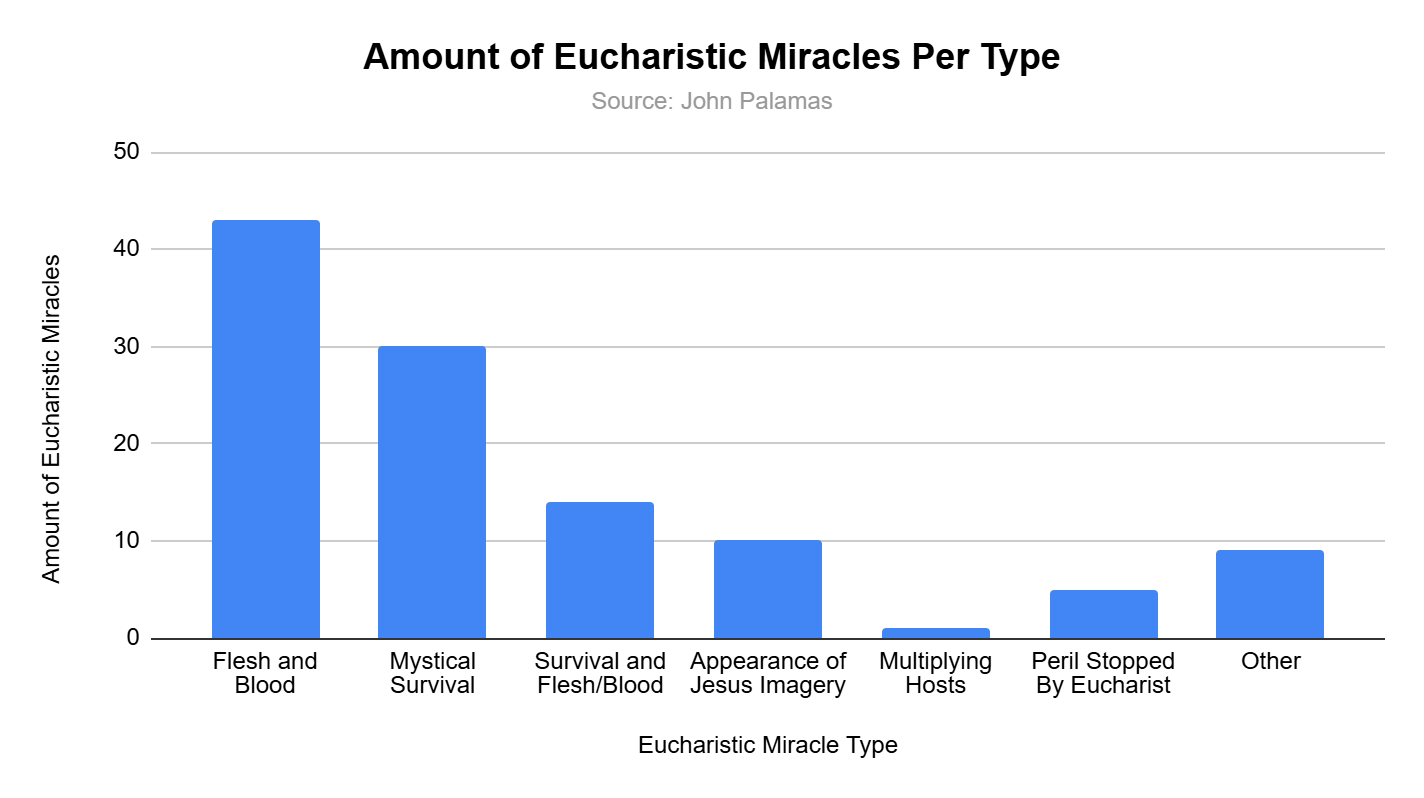
This went along more or less as I expected. Flesh and Blood miracles are the most common (and the most talked about), while other miracles like the Appearance of Jesus Imagery, Multiplying Hosts, Peril Stopped by Eucharist, and Other, are less prominent. The only surprise was the amount of miracles involving Mystical Survival along with Survival and Flesh/Blood, which combined are about as plentiful as the Flesh and Blood miracles are alone. I was surprised by this because this type of miracle is not talked about at all, at least relative to the Flesh and Blood ones. No one is talking about the Eucharistic miracle of Alboraya-Almacéra, but they are all over Lanciano and Buenos Aires. Why? Looking at the propensity of the different miracle types over time will give us an answer.
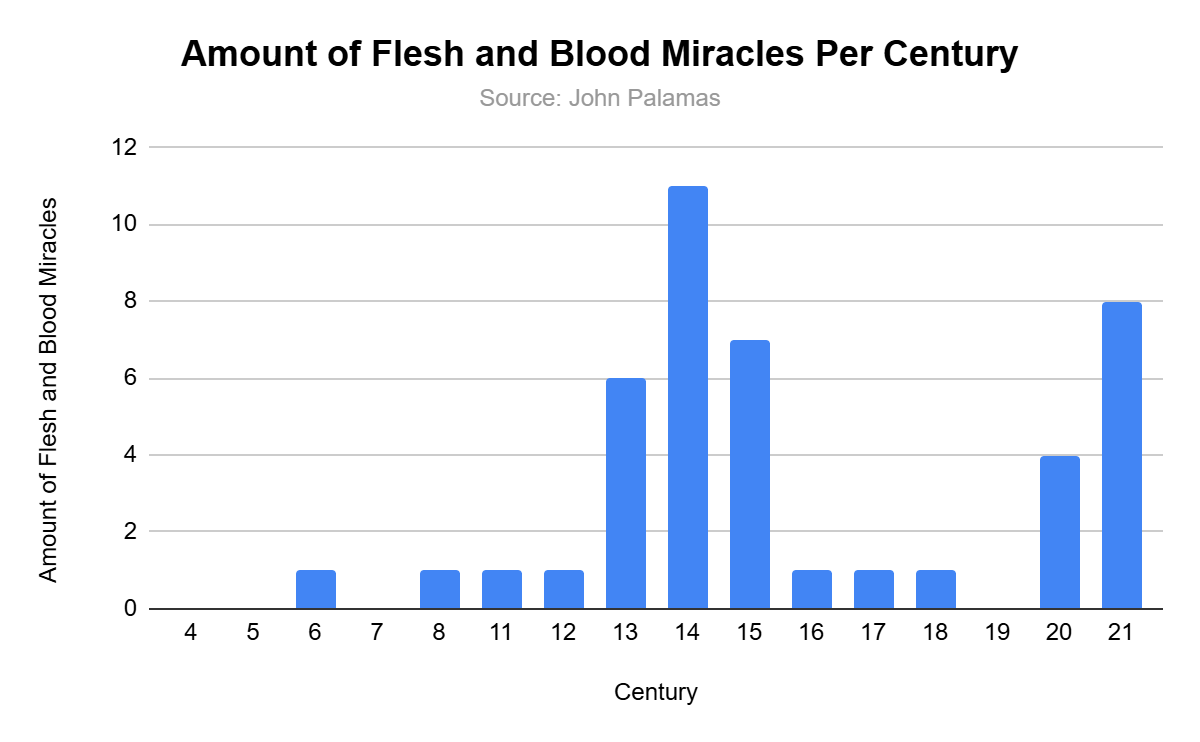
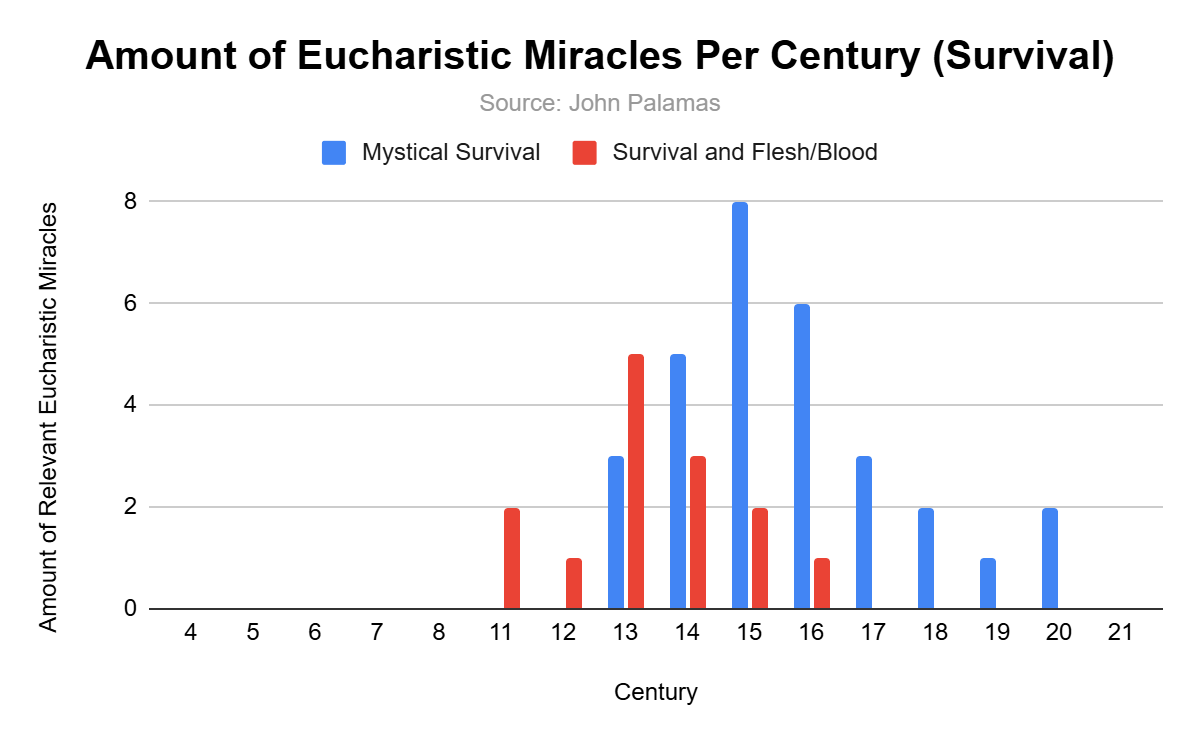
The reason for the disparity in interest is because Flesh and Blood miracles still happen, while Survival miracles do not. Survival miracles had a heyday, but are not found in the modern era. This is particularly true for miracles that involve both Flesh and Blood and Survival, which have not occurred since the 1500s! Each and every one of these miracles deserves far more study than they currently have, but one can, for purposes of internet polemicism at least, hand-wave away miracles of Mystical Survival as just persistent legends of a bygone age, that have now disappeared in the more rational modern world. This cannot be done with Flesh and Blood miracles, which are on track to have their most prolific century ever!
But what about the other types of miracles? When were they most prominent, and do they still occur?
First of all, there has only been one miracle in the category of Multiplying Hosts: the 2023 miracle in Thomaston, Connecticut, which, as far as I can tell, is still under investigation by the Vatican. The novelty of this category is strange, and I wonder if this is just a one-off, or if these miracles will continue to occur, with this being just the first case. It has to start somewhere!
The next type, the Appearance of Jesus Imagery, seems to be going strong:
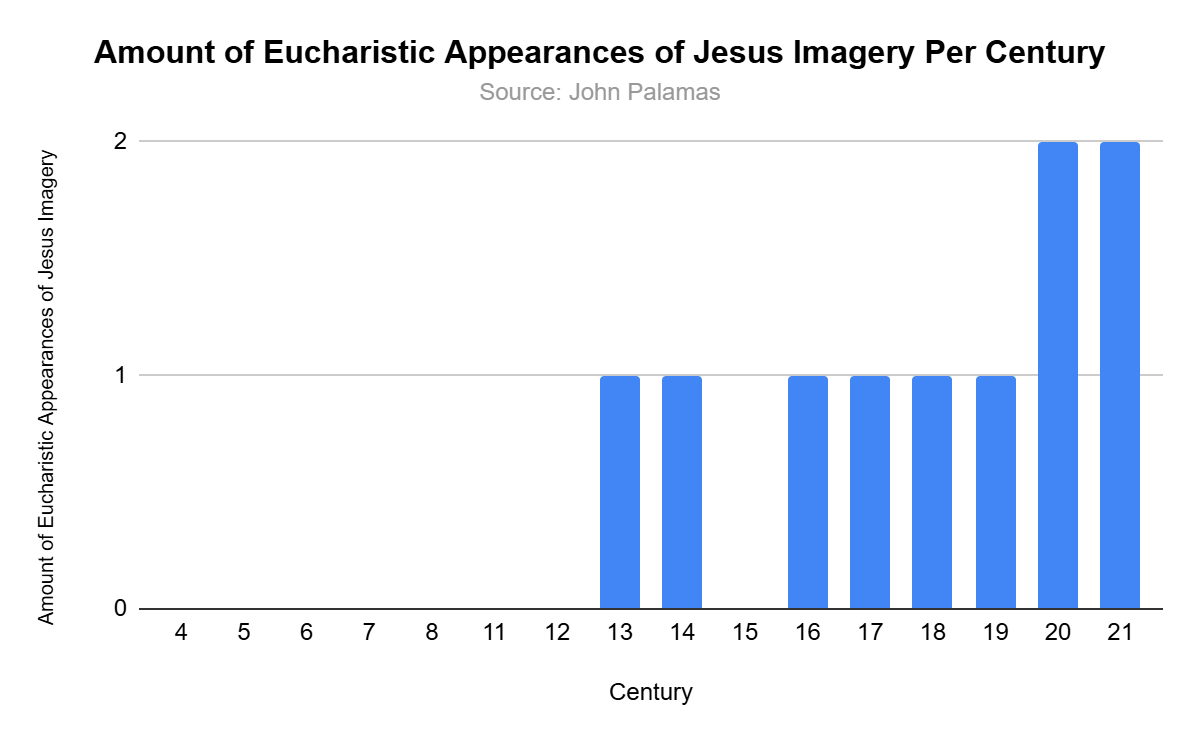
While less famous, and less prolific, than those involving Flesh and Blood, miracles relating to the Appearance of Jesus Imagery have been going steady for hundreds of years, and have only increased in the last century. These cases, too, cannot be hand-waved away as unfounded legends, but would require individual case-by-case analysis.
Finally, let’s take a look at the cases of Peril Stopped By Eucharist, and the events in the Other category:
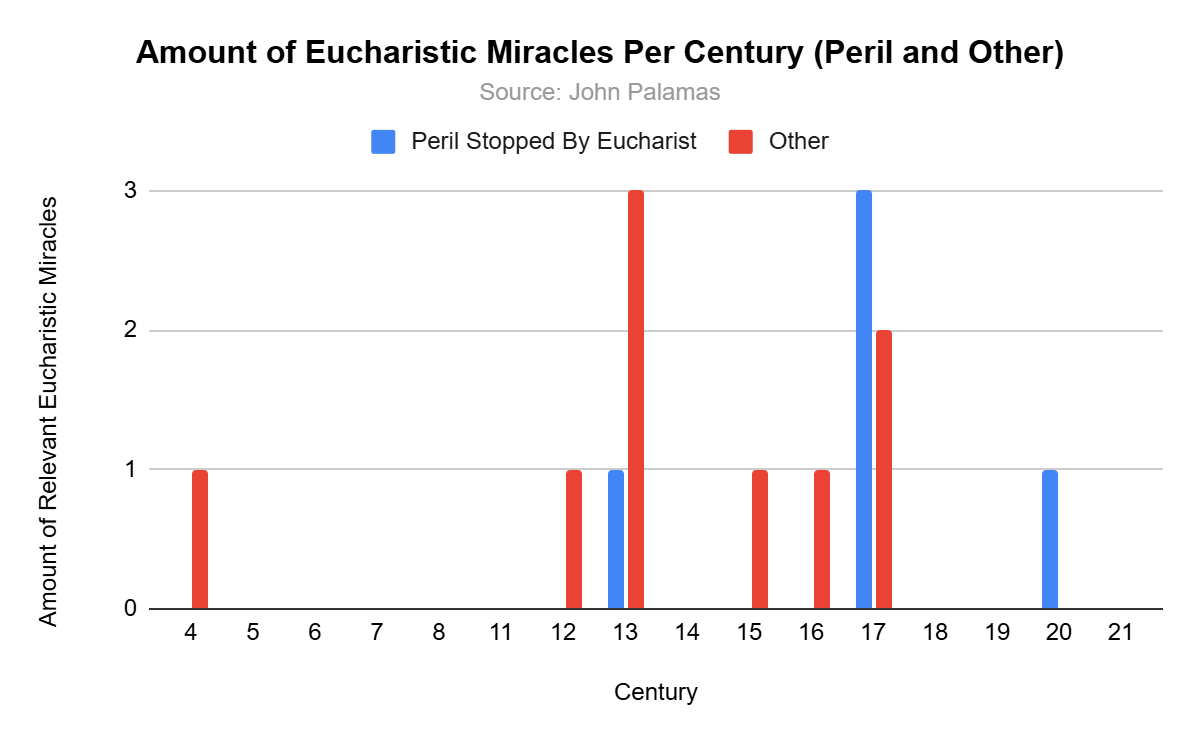
These miracles, often involving deeply strange and incredible stories, could be reasonably seen as objects of premodern folklore rather than of objective fact. A claimed case of a Peril Stopped By Eucharist has not occurred in over 100 years, and the cases in the Other category are plainly seen to have stopped before the modern era.
Now that the types of miracles have been analyzed, the prevalent motif of the doubting priest (or other Catholic) will be visualized. It was to my prior belief that these cases were probably fictional, and if they had any true core to them, the doubting priest was added as a moral lesson to defend transubstantiation. Let’s take a look:
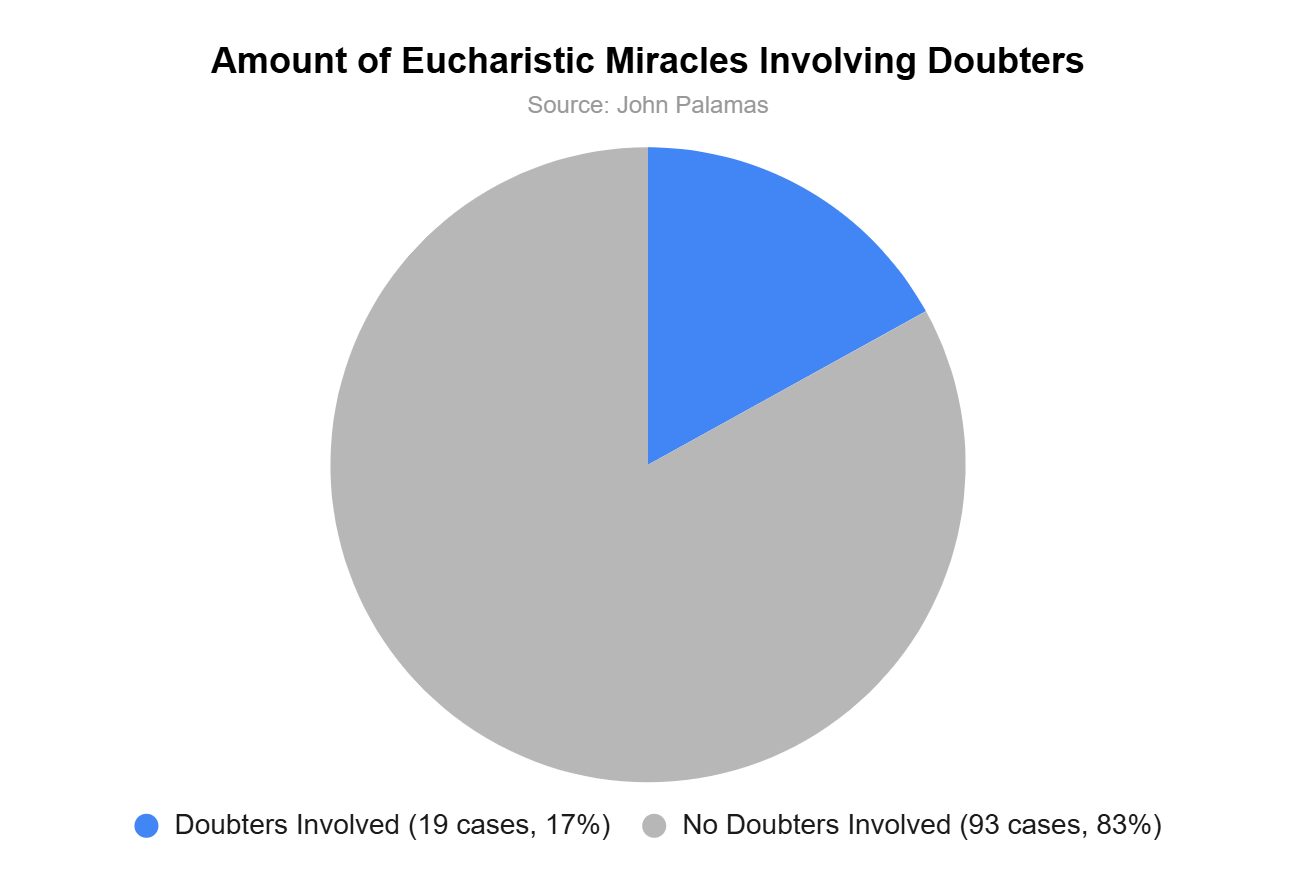
Most miracle cases (83%) do not involve the doubter motif, but a substantial minority (17%) of cases do. This includes some quite famous cases like the Eucharistic Miracle at Bolsena (thought to be influential in establishing Corpus Christi), and the Lanciano case, which a number of people5 go to bat for even today. Once you see the visualization by century, you can see why I am pretty skeptical of these miracles.
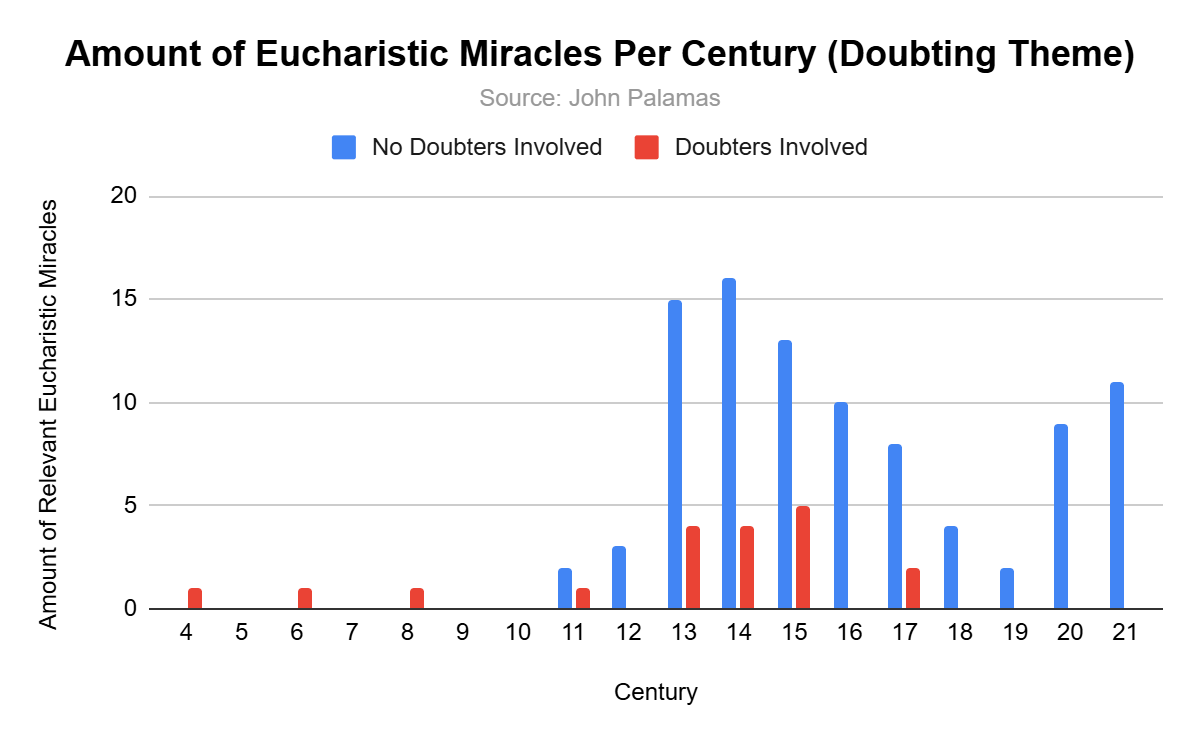
Sorry Ethan, but it seems like the Doubter stories are likely a figment of medieval imagination, for a variety of reasons.
First, while the other Eucharistic miracles have continued each century since their emergence in the 11th century, the Doubter stories end by the 1600s. Secondly, some of the Doubter stories are those considered the oldest of all of Eucharistic miracles, and their claimed age sticks out like a sore thumb when placed along with the non-Doubter cases. Lanciano, for instance, is claimed to have happened 3 centuries before the broader trend of Eucharistic miracles did.6 Looking more broadly, the non-Doubter cases start in the 11th century, and have continued in every century since. The Doubter cases occur in the 4th century, then the 6th, then the 8th, then broadly follow the trend of the non-Doubter cases from the 11th century onwards, until they disappear in the 17th century.
The paucity of these miracles in modernity, their anachronistic ages, and the implicit suspicion that comes with their moral lessons leads me to have higher skepticism towards these miracles than I do those without the Doubter motif.
Finally, just for fun, let’s look at which countries have the most Eucharistic miracles.
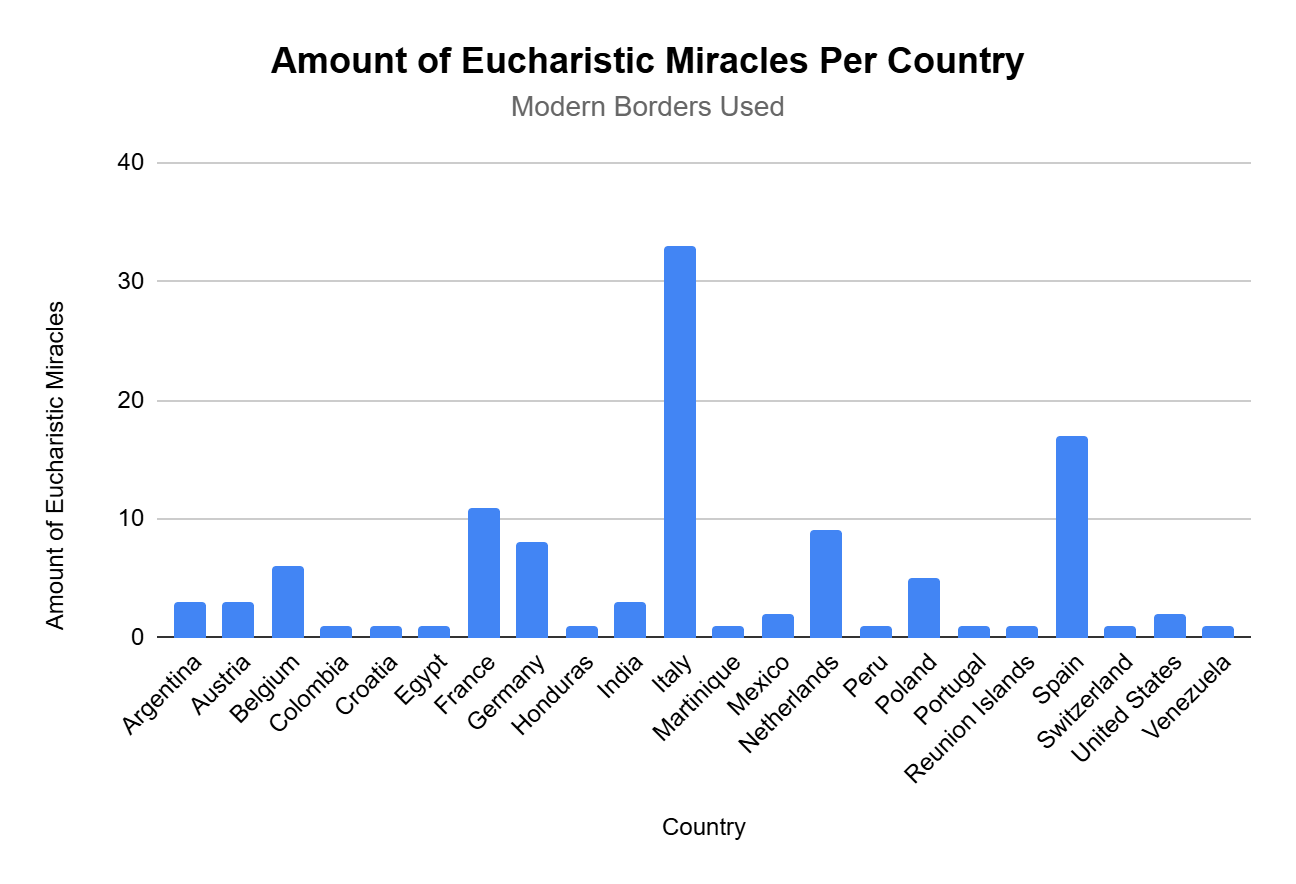
Perhaps unsurprisingly, Italy takes home the gold for having the most Eucharistic miracles. Just in time for the Olympics! Spain gets silver, and France is left with bronze. The only surprising presence on the list is India, which I would have not have assumed could beat out the numerous traditionally Catholic countries like Mexico or Portugal that make up the rest of the list.
Conclusion
Alternate title: TLDR.
So what have we learned?
To start, Eucharistic miracles are, even with newfound popularity, a deeply unexamined subject. In a perfect world, each case would be subject to a deep analysis on its own merits before jumping to broad conclusions like this. But, seeing as the field of Eucharistology is in its infancy, new perspective was gathered through a sweeping statistical analysis. To complete this statistical analysis, a new dataset was created in which all available miracle cases were collected and categorized into relevant types for the first time. They were mostly sourced using the Carlo Acutis list, along with notable recent cases found on Wikipedia.
A number of important facts and insights were gleaned:
The trend pointed out by Skeptasmic of a stark increase of miracle cases after the Fourth Council of the Lateran in 1215, when transubstantiation was codified, is replicable. As is the noted decrease of cases with the advent of the Protestant Reformation, when transubstantiation fell out of favor in large swathes of Europe.
What was not found by Skeptasmic was the great increase in Eucharistic miracles in the 21st century. This trend does not have an easily identified naturalistic cause, and it in some sense reduces the force of the previous attack on Eucharistic miracles by linking earlier swings in quantity to naturalistic causes.
The 21st century is on track to have more Eucharistic miracle claims than any century before it!
Categorizing the miracles into types bore new fruit. The Flesh and Blood miracles were found to be the most prolific, followed closely by those involving Mystical Survival, and both Survival and Flesh/Blood.
Miracles in the category of Flesh and Blood and the Appearance of Jesus Imagery have longstanding histories and continue to be reported in the 21st century, often at higher rates than in previous centuries. In my view, this increases their categorical credibility.
Miracles in the category of Mystical Survival, Survival and Flesh/Blood, Peril Stopped By Eucharist, and Other peaked in the post-1215 medieval period and essentially stopped being reported by the advent of modernity. In my view, this decreases their categorical credibility.
In 2023, a new type of miracle, that of Multiplying Hosts, was first reported. Its only case is still under investigation by the Vatican, and it remains to be seen whether new cases will arise in the future.
In many cases, a motif was present of a doubting priest or other Catholic coming to believe in the Real Presence or Transubstantiation after witnessing a Eucharistic miracle.
Cases were broken up into categories of non-Doubters (~80%) and Doubters (~20%). Non-Doubters showed a consistent pattern of occurrence: after first appearing in the 11th century, they spiked in the 13th century, declined during the Protestant Reformation through the 1800s, recovered during the 20th century, and seem to be spiking again in the 21st.
The Doubter cases did not form a consistent trend of occurrence. Some dates of their apparitions seemed anachronistic, and all occurrences of Doubter miracles ceased by the 1600s. Both of these facts seem to serve as an indictment of their categorical credibility, along with the previous suspicion about concocted moral lessons. Some famous cases, like the miracle at Lanciano, are afflicted with many of these concerns.
The countries with the most cumulative miracle occurrences are Italy, Spain, and France. Eucharistic miracles generally take place in nations that have Catholicism as a high percentage of their religious affiliation. The notable exception to this trend is India, which has hosted a number of miracles despite its exceedingly low percentage of Catholics.
I hope this analysis was able to shed new light on the topic of Eucharistic miracles, and bring forward a field of study that has sadly been neglected and unexplored until very recently. I also hope this dataset can be useful to other interested researchers into this topic. I may make an updated dataset in the future, and I will be sure to share my results then as I have here.
As a final note, I would just like to comment that this is my very first Substack post, and if this sort of research is something that you would be interested in, please subscribe! I am focusing on Eucharistic miracles for now, but I believe that I will branch out further in the future.
Update 4/18/2026 - I have found that one error slipped into the dataset. That being the Dallas miracle was found by Church authorities to be of natural origin, and should not have been included. Due to the size of the dataset (and the fact that I probably missed at least one 21st century miracle), conclusions are not at all effected. The dataset itself will not be edited for sake of consistency.
The Buenos Aires cases are particularly famous because the future Pope Francis was the local Archbishop investigating the case.
Or lack thereof, depending on who you ask.
Which is technically not actually his list, but that will be addressed in a future post.
I can think of a lot of strong rebuttals to these explanations, but at this point it would waste time to go through them.
Looking at you, Ethan Muse.
Hi. Sorry, my graph was a rather half-assed attempt to quickly make a visual, and I wasn't expecting anyone to pay much attention to it. I just quickly took an existing spreadsheet and got excel to generate a quick graph based on the dates. The original intent of the spreadsheet was to have a list to write the chancery of each diocese and actually find out which claimed Eucharistic Miracles are approved by the bishop. If you want the list I used, there should be a copy on my backup at home from September that would be pretty close to the time I made it. Because the list is a work in progress my current version won't match, but might be more useful to you. It's a bit of a mess though.
The spreadsheet was created by jotting down information as I stumble across it, so it's certainly not the most organized process. It includes all of the EMW list (the one you are calling Acutis's list), except I removed ones that have nothing to do with the Eucharist, as you did. I can't remember if I had gone through the "saints" portion of the list at that time, so those may have been missing. It also includes some from previous versions of that project by Mrs. Acutis and Mr. Meloni, links people have sent me, a few books and papers on the history of Serratia marcasens and desecration of the host libel, and books I've read chasing down the sources of other claimed miracles, which I do in a fairly haphazard manner.
For example, I noted that most of the books on desecration of the host libel state that there were no cases before the 13th century, so I decided to look into the bloody ones EMW shows as earlier than that date. So I started looking at Trani, because that's the earliest bloody one after Lanciano, which I already knew there's no early records was. I traced down the source (easier said than done, they got both the title and the author's name wrong, but it's still better than most of them that have no citations at all) read the book, and found that he has 19 more claimed Eucharistic Miracles in there. So I wrote down the date and the city for the one that has one. One of the others is recognizably Paris, though it doesn't specify. Most of the others are clearly not duplicates, but none had both a date and a location, so I couldn't add them to the list.
So yeah. It's not a great procedure for gathering statistics. Inherently if I'm reading a book written in the 16th century any miracles it mentions are going to be older than that. But I don't really have a better solution. Ideally I would use only the ones approved by the Church, but the whole reason my spreadsheet exists is that that information isn't available.
At the time, my intent was to show the drop off at the Protestant Reformation. I wasn't paying attention to the modern period. There has unquestionably been an uptick in Eucharistic miracle claims since 1972 when leaving wafers soaking in water for weeks became common. The Church is, wisely, generally not publicizing them. For example there are 25 in this paper alone https://pubmed.ncbi.nlm.nih.gov/40042646/ , and I can't match any of them to a known case. I expect that will continue until the Church either declares that the Real Presence ceases within a few hours after the wafer is placed in water (which would presumably nullify all of the claims that occurred later) or decides that placing them in water and letting them slowly rot is not a respectful way to dispose of them. I can't honestly imagine the current protocol persisting. I've spent a lot of time watching wet wafers rot, and imagining that they could be Jesus's living flesh slowly decaying is a pretty disturbing image.
There has also been an uptick in other claims, and I'm sure Acutis's canonization will inspire plenty of frauds. So I certainly expect there will be an increase, I just don't think many will survive scrutiny.
I feel like I've seen some references to multiplying hosts in the middle ages somewhere, but it doesn't look like I wrote it down. Possibly "Miracles and the Mediaeval Mind" by Benedicta Ward, I think I read that before I started the spreadsheet.
The other popular category you're missing from the Middle Ages is death-by-Eucharist. Those weren't on the EMW list, presumably because they're unpalatable for a modern audience, but back then it was believed that God would often strike people dead for taking the Eucharist unworthily, and there are lots of really gory stories, usually involving Eucharists bursting out of people's throats as they swallowed.
As far as location goes, I think every book I've read on the subject has agreed that the Rhine Valley in Germany was the hotbed. It's said that practically every parish had a bloody wafer at one point. I've actually been wondering why none of them are on the EMW list. Most of them were desecration of the host libel cases, but they have Brussels on there. My guess is that the social and legal situation after World War II made the Church clamp down on these stories, and they're a little better suppressed there than in other areas.
One book I read noted that Italy had surprisingly few cases that accused Jewish people, so it's possible that as a result more stories survived to the modern day. But your main source was also written by Italians, at a time when translating foreign languages was more difficult, and their procedure was as haphazard as mine. I suspect that biases the results. Although, as you note, it wouldn't be surprising if Italy did have a lot of cases.
It seems to me that the increase in recent miracles is related to what is actually very fertile ground despite initial appearances. Religiosity is down, yes, but that is a result of doubt due to science, and some modern cognitive theories suggest that doubt can only occur when someone already has belief, meaning there is a bias towards confirmatory evidence despite it looking on the surface like the opposite is true. If there is a dynamic of decreased religiosity due to doubt that arises from increased belief in science, then once you get the first scientifically-"confirmed" Eucharistic miracle, lots of people who are doubting would see that as a way to reconcile their cognitive dissonance, and you'd see a cascade of new miracles that fall into that same type. And that's what we see: a lot of miracles that happen to be of the type that was first scientifically "confirmed" and is also able to be confirmed with the most robust scientific reasoning.